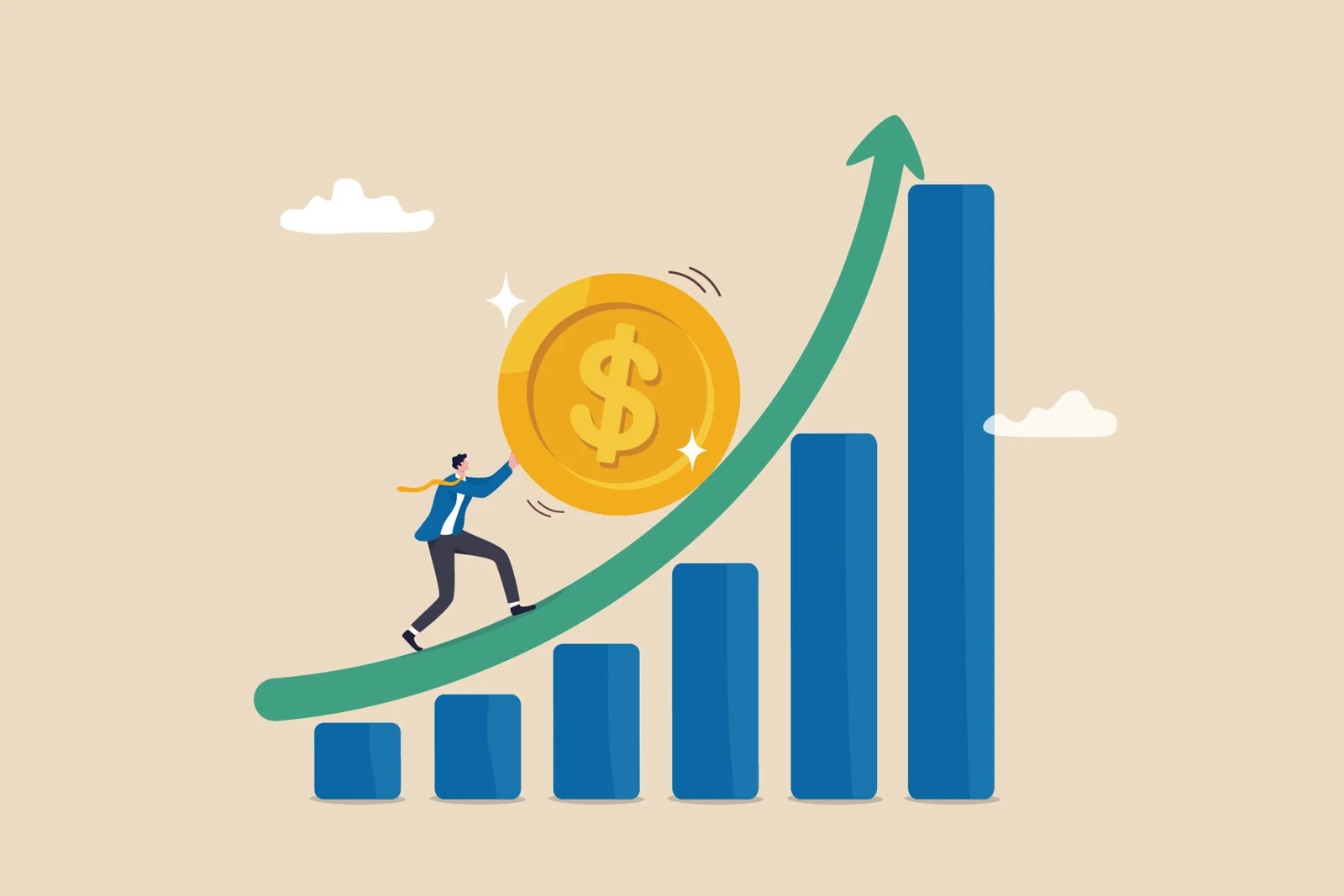
Many people hear the term "compound interest" and immediately think of confusing finance jargon, but in reality, it is a surprisingly simple concept that can have life-changing effects on your financial future. It’s like planting a small seed and watching it grow into a mighty tree over the years. Compound interest allows your money to grow faster than you might expect, making even modest savings grow significantly over time. The effect is often described as the snowball effect, where small initial contributions gain momentum and accelerate into substantial wealth.
Understanding compound interest is essential for anyone who wants to grow wealth, save for the future, or even just understand how their money works. Unlike simple interest, where you earn a fixed return only on the initial investment, compound interest ensures that every bit of your earnings also starts working for you, creating a chain reaction of growth. This reinvestment principle is the secret behind turning small investments into major financial achievements over decades.
While it might seem slow at first, especially in the early years, the true power of compound interest becomes astonishing when you give it time. Even starting with just a few dollars a month can result in impressive wealth if you are patient and consistent. Let’s dive deeper into the mechanics and examples of how compound interest works, so you can harness this financial magic for yourself.
What Exactly is Compound Interest?
Compound interest is essentially interest on interest. That means you earn money not only on the amount you initially invested, known as the principal, but also on all the interest that accumulates over time. This differentiates it from simple interest, which only calculates returns on the principal amount and ignores accumulated interest. Because of this, compound interest accelerates the growth of your investment, making it an incredibly powerful financial tool.
For example, if you invest $1,000 at 5% interest per year, simple interest will give you a flat $50 every year, totaling $1,250 after five years. Compound interest, however, calculates the interest on the growing balance each year, so after the first year, you earn $50, but in the second year, you earn $52.50, because it is based on $1,050. By the end of five years, your balance grows to $1,276.28. The difference might seem small initially, but over decades, it becomes massive.
Compound interest works in such a way that the more frequently interest is added to your balance, the faster your money grows. Reinvestment is the engine behind this system, and over long periods, it can create wealth far beyond what most people expect. This is why early investment is often touted as one of the most important financial habits to develop.
How Does Compound Interest Work?
The magic of compound interest lies in three factors: time, rate of return, and the frequency of compounding. Each plays a crucial role in determining how quickly your money grows. Time acts as a multiplier, while the rate of return determines how much growth occurs, and compounding frequency dictates how often that growth is applied to your total balance.
Time is the most crucial ingredient. Even small investments, when left untouched for decades, can result in impressive sums. For example, a modest $200 monthly investment starting at age 25 can grow to nearly half a million dollars by age 65, assuming an average annual return of 7%. Waiting just 10 years longer to start, however, halves that potential wealth, demonstrating how critical early action is.
Compounding frequency also makes a noticeable difference. Interest can be compounded annually, semi-annually, quarterly, monthly, or even daily. The more frequent the compounding, the faster your money accumulates. Small differences in frequency might seem trivial at first but can result in thousands of extra dollars over a lifetime.
Lastly, the rate of return magnifies growth. Even a slight increase in interest rates can significantly increase your balance over time. For example, a 10% return compounded monthly over 30 years produces substantially more wealth than a 5% return compounded annually. This demonstrates why both early investing and seeking reasonable rates of return are essential strategies.
Let’s See It in Action
To better understand compound interest, let’s look at how a $1,000 investment grows under different interest rates and periods. A 5% annual interest rate over 10 years results in $1,628, while a 7% rate reaches $1,967. With a 10% rate, your $1,000 grows to $2,594 in the same period. Over 20 years, the difference becomes even more dramatic, highlighting how small changes in rate can create huge differences in long-term wealth.
Time alone can be astonishing. Over 30 years, $1,000 at 5% interest grows to $4,321, at 7% to $7,612, and at 10% to $17,449. The exponential growth shows why starting early is one of the most impactful financial decisions anyone can make. The snowball effect is most visible here: the longer you allow your money to grow, the more dramatic the compounding effect becomes.
Compounding frequency also changes outcomes. A $1,000 investment at 5% annual interest compounded annually grows to $4,321 over 30 years, but if compounded monthly, it reaches $4,481. This demonstrates that not only time and interest rates matter but also how often your investment is allowed to compound. Small tweaks in compounding can have a significant impact over long periods.
The Key Ingredients: Time and Reinvestment
The real power of compound interest comes from consistent reinvestment. Each new compounding period begins with a larger principal, which accelerates growth. Without reinvestment, you lose much of the potential of your investment. The process is simple: keep earnings in the account and let time do its work.
Starting early cannot be stressed enough. Even modest contributions can grow exponentially over decades. Consider a 25-year-old investing $200 monthly at 7% annual return: by retirement, their account could exceed $480,000. Someone starting at 35, with the same monthly contribution, might only reach $240,000. The difference highlights the critical importance of early and consistent saving.
Reinvestment combined with time creates a compounding engine. This is why many financial advisors emphasize starting small and letting contributions grow steadily. Even irregular or small contributions compound remarkably over time if left untouched.
The Benefits of Compound Interest
Compound interest makes money work harder than almost any other financial strategy. Here are some key benefits:
Firstly, it grows investments faster than simple interest or cash savings alone. A $10,000 investment at 6% monthly compounding grows to over $18,000 in just ten years, almost doubling your wealth. Secondly, it helps protect against inflation. By earning returns on your previous earnings, your purchasing power is more likely to keep pace with rising prices.
Compound interest is versatile. Whether saving for retirement, education, or wealth accumulation, it works for a variety of goals. Thirdly, it rewards consistency. Regular contributions, even small ones, can snowball into significant amounts over decades, emphasizing the importance of habit over occasional large deposits.
Real-World Examples
Compound interest isn’t just theoretical—it impacts everyday financial decisions. Savings accounts and certificates of deposit (CDs) compound interest, usually daily or monthly. A $10,000 deposit at 4% interest compounded quarterly would grow to $12,682 in six years. Retirement accounts like 401(k)s or IRAs also benefit heavily from compound interest combined with tax advantages.
Unfortunately, compound interest also applies to debt. Credit cards or loans with high interest rates can compound against you, increasing the total owed over time. For instance, a $5,000 credit card balance at 20% annual interest compounded daily can grow to more than $6,100 in a single year if unpaid. This dual nature of compounding—both positive and negative—is critical to understand.
Maximizing Your Investment with Compound Interest
To fully benefit from compound interest, use planning tools like Excel, online calculators, or financial apps. These can help project growth, set goals, and track progress. For example, $10,000 at 5% annual interest compounded monthly over 20 years can grow to around $33,066, illustrating the long-term impact of small, consistent efforts.
Investors should pay attention to fees, taxes, and inflation, which can reduce the effective growth of their investments. Choosing low-fee accounts and tax-advantaged options is important. Regularly reviewing your investments ensures your money keeps compounding efficiently over time.
Challenges and Misunderstandings
While powerful, compound interest isn’t instant. Many people underestimate how long it takes to see substantial results. Starting late or expecting quick gains can lead to disappointment. Patience and consistency are key.
Inflation, taxes, and fees can all erode gains. Inflation reduces the real value of money, taxes take a chunk of your interest earnings, and high fees can slow growth. Awareness and careful planning are necessary to maximize compound interest benefits.
Not all investments compound automatically. Ensure your returns are reinvested, otherwise, your potential for growth diminishes. Many mutual funds, ETFs, and savings accounts offer automatic reinvestment, making it easier to leverage compounding.
Overall, My Final Words So Far
Compound interest is one of the most powerful concepts in personal finance. Its ability to turn modest savings into substantial wealth over time is unmatched. The earlier you start, the more you benefit. Reinvesting your earnings ensures that your money grows exponentially. Even small, consistent contributions can snowball into significant wealth over decades.
Whether you are saving, investing, or managing debt, understanding compound interest can make a huge difference in your financial life. Start today, be consistent, and let the magic of time work for you. Remember, patience and regular contributions are far more effective than trying to find a single “big win” investment.
Ultimately, the power of compound interest demonstrates that time is one of the most valuable assets in building wealth. Begin early, reinvest your earnings, and watch as your small contributions turn into something remarkable. It might take years, but the payoff is worth the wait.